In the Interim: 2/21/20

meg-rileyOne of my go-to books for resilience-building is Pema Chodron’s classic, When Things Fall Apart: Heart Advice for Difficult Times.  I picked it up years ago at a bookstore when it screamed at me, “Here’s the book you need right now!”  Over the years, I have gone back to it and found it a trusty friend.

Chodron is an American Buddhist nun.  Her other books have titles like, The Places That Scare You, Comfortable with Uncertainty, Practicing Peace in Times of War.  All useful books but this first one that I found (though not the first she wrote)  brings me back over and over.

Essentially, the book is full of practices and insight about how to have more compassion for ourselves.  Chodron writes:

“Learning how to be kind to ourselves, learning how to respect ourselves, is important.  The reason it’s important is that, fundamentally, when we look into our own hearts and begin to discover what is confused and what is brilliant, what is bitter and what is sweet, it isn’t just ourselves we’re discovering.  We’re discovering the universe…To the degree that we look clearly and compassionately at ourselves, we feel confident and fearless about looking into someone else’s eyes.”

Self-awareness and compassion for ourselves is an essential piece of resilience. Resilience isn’t a badge to earn, a medal to be awarded, a state of being that we claim as our own.  Resilience is a daily practice of centering into our own selves, opening our eyes to those around us, and claiming our own place in the world. Continue reading →

In the Interim: 2/14/20

terri-burnorDuring story time in worship a few weeks ago, Jennifer Swick, our wonderful acting director of family ministries, taught us box breathing (or square breathing). This is a fantastic practice for children and adults because it really helps to calm down heightened anxiety, nervousness, over excitement, or meltdowns right there in the moment. And it’s so easy —just breathe and count. We can all do that!

As a refresher or for those who weren’t at church that day, here’s how it works. Exhale all the way out to get started. Then inhale for a count of 4, hold for a count of four, exhale for a count of 4, hold for a count of four. Repeat as many times as you like, being mindful of any dizziness or shortness of breath. You can change the count number and even add hand motions, like Jennifer showed us (I bet she’ll give you a personal tutorial if you ask!). If you like visual queues, here’s a fun video with puffer fish to help keep count.

I love body-based practices, especially breath work. As Resma Menakem teaches us, “when you can settle your body, you are more likely to be calm, alert and fully present, no matter what is going on around you. A settled body enables you to harmonize and connect with other bodies around you, while encouraging those bodies to settle as well.” Continue reading →

In the Interim: 2/7/2020

arif-mamdaniRecently, someone gave The Book of Joy: Lasting Happiness in a Changing World a big huge wholehearted recommendation, and even encouraged listening to it as an audiobook. In the midst of preparing to see the Ministerial Fellowship Committee in March, I haven’t felt like I had the luxury of reading anything that isn’t on the MFC reading list, but an audiobook sounded possible, and in the dreariness of this winter, I could sure use some joy.

So, with a free trial of Audible in hand, I downloaded the book and spent about 2 weeks listening to it in the car, at the gym, and sometimes in the shower. And now I’m giving it a big, huge, wholehearted recommendation to you! Continue reading →

In the Interim: 1/24/20

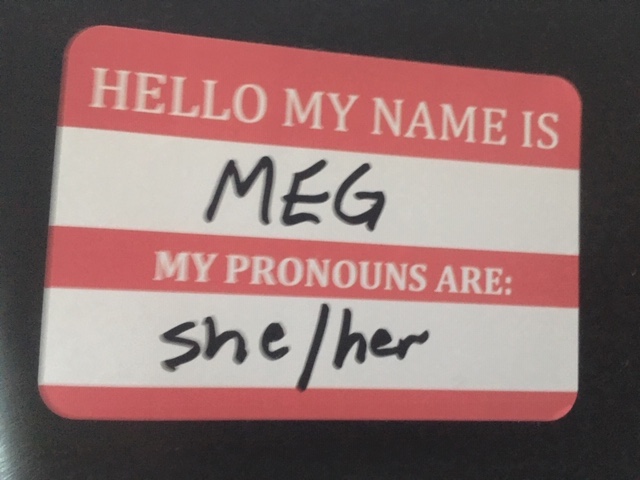
meg-rileyI was at a dinner last week with a woman who works at 3M. She told me that they had now been requested, in their email signatures, to include their pronouns.

What that means, if it’s not a familiar concept to you, is that people who identify as female write she/her/hers under their names. People who identify as male write he/him/his. People who use other pronouns might write they/theirs if they use singular they pronouns, or any number of pronouns which have been invented to convey that neither he nor she is a good fit: zi/ si/ ey/ ve/tey / xi and so many others. This tells the rest of the 3M community how each person would like to be addressed.

If this is a new concept to you, here is a webpage that begins to explain gender pronouns:
https://www.transstudent.org/pronouns101

IMG_1295

There is most definitely a gender revolution going on. It’s even hit 3M! Those of us who are older may have trouble feeling that we can keep up with it all. This Sunday, we’ll be exploring what that means for all of us, and featuring the voices (in music and word) of people who have lived outside of the “cisgender” identity. (Cisgender refers to those of us who identify with the gender we were assigned at birth. For us, especially, this may mean that we have never given much thought to expanding concepts of gender.) This is part of our theme of integrity, as we explore what it means to have integrity in our genders. Continue reading →

In the Interim: 1/17/20

terri-burnor“May your life preach more loudly than your lips.” — William Ellery Channing, theological founder of American Unitarianism

Integrity and values cannot be separated from one another. How we live a life of integrity is reflected in the values we hold at the heart of things. For if our values are indeed our values, they cannot just be said, but must be expressed. They must go somewhere, be alive somewhere, create movement somewhere, affect change somewhere.

Oh but values are a tricky business. They can be super inconvenient! And so we sometimes wrestle with, swear at, bargain with, forget, deny, ignore our values. We may struggle with perfectionism and feel embarrassment, guilt and even shame when there’s a gap between what we truly believe and how we show up in life.

All of these things are true for me, and I’m guessing that they are for you as well.

We are human. Hear us fail (and roar). See us rise! Let us remember that we can keep keep coming back to love, that we are held by love, that we are loved. We fail, we rise, again and again. We do this because it’s what our values, our faith, our interdependence call us toward. Continue reading →